
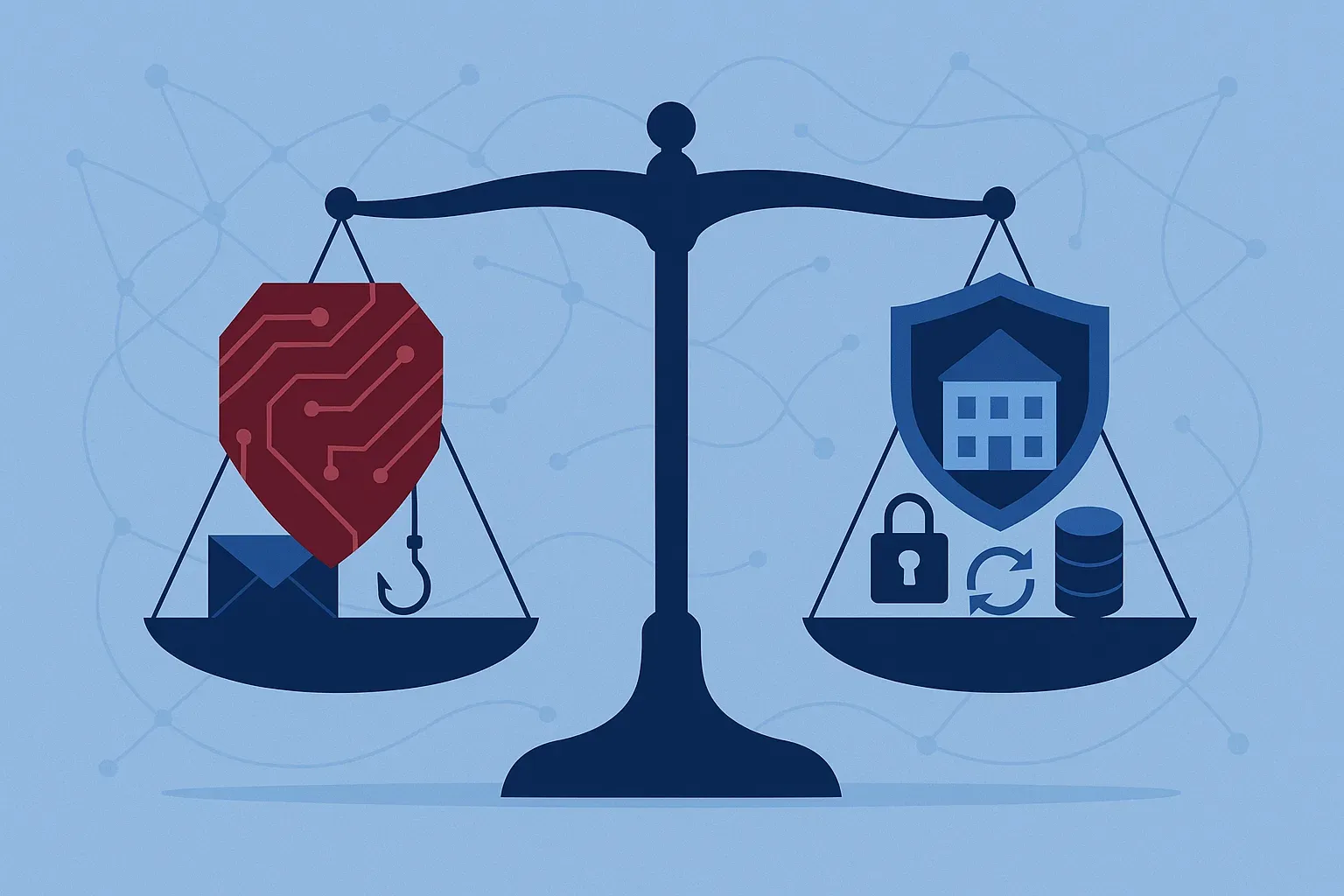
Artificial intelligence is showing up on both sides of cybersecurity. Large software companies are using it to comb through their own code for flaws before criminals find them. Security tools use it to spot unusual behavior in mountains of data no person could read. And attackers are using it too, to write better scams faster.
For a business owner in Friendswood or Kemah with fifteen employees, the headlines can feel far away. So here's our plain-English take on what's shifting, what isn't, and what's worth doing about it.
Shift one: scams look a lot more convincing
For years, the easy way to spot a phishing email was clumsy grammar and odd phrasing. That clue is fading. AI writing tools let a scammer produce a polished, friendly, error-free message in any tone, tailored to your company using details pulled from your website and social media.
Voice is getting harder to trust as well. It's now possible to imitate someone's voice from a short audio sample, which makes a "quick call from the owner" asking for a wire transfer more believable than it used to be.
What to do about it:
- Require that any request to move money or change bank details be confirmed by calling a known number, never the number in the message
- Update staff training so people judge what's being asked, not how well it's written
- Protect email with multi-factor authentication and security screening, since so many of these schemes begin in the inbox
Shift two: flaws get found, and fixed, faster
As software makers point AI at their own products, more vulnerabilities will be discovered and patched. Attackers are doing the same thing from the other direction, hunting for weaknesses to exploit. The gap between a fix being released and criminals taking advantage of the flaw is already short, and it's likely to shrink.
That puts real weight on something unexciting: keeping every computer, server, firewall, and application updated on a regular schedule. The businesses that get hurt are rarely the ones hit by some exotic new attack. They're the ones running a laptop that hasn't installed an update in four months.
Shift three: defenders get better tools
The good news is that the same technology helps protect you. Modern endpoint protection and monitoring tools use machine learning to notice behavior that doesn't fit, like an account suddenly signing in from another country or a program trying to encrypt files in bulk. That lets a security team respond in minutes instead of discovering the damage days later.
The catch is that those tools still need people behind them. An alert at 2 a.m. only matters if someone is awake to act on it. That's a big reason small businesses work with a provider for network security rather than buying software and hoping for the best.
What doesn't change
Here's the part that rarely makes the headlines. However advanced the tools become, the break-ins we see at small businesses still tend to start somewhere familiar. An email account that never got multi-factor authentication. A password used on five different sites. An update that was postponed one too many times. An employee with far more access than the job required. A backup that turned out not to work on the day it was needed.
AI doesn't make those openings go away. If anything, it helps attackers find them faster and at greater scale. Here's a quick self-check for this week:
- Is multi-factor authentication turned on for every email account, including the owner's and any shared mailboxes?
- Is your team using a password manager rather than recycling passwords?
- When did your computers last install updates, and who is checking?
- Does anyone have administrator rights they don't need day to day?
- Have you restored a file from backup in the last few months, just to prove it works?
If you answered all five with confidence, you're ahead of many small businesses. If not, those are the places to start, long before worrying about the next AI breakthrough.
Our take
AI will keep changing how attacks look and how defenses work, and we'll keep adjusting our tools as it does. The foundation stays the same, though: good habits, current software, limited access, working backups, and someone watching. We've been helping Houston-area businesses with that since 2010.
If you'd like an honest look at where your business stands, book a discovery call with us.